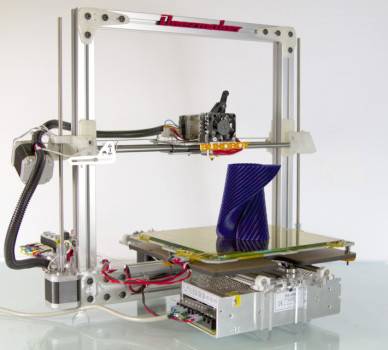
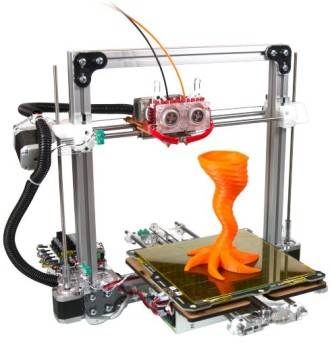
You can create almost anything you can dream up with a Bukobot 3D printer, right on your desk!

The Buko framework is the next generation of Open Source 3D Printers. 3D printers using this new framework are called Bukobots.
With many months in development, I have combined the best ideas from the open source community and some new ideas of my own into an extremely flexible open source 3D printer design. Following the traditions of “Reprap” 3D printers, the new Buko framework design is self-replicating and does not require any special machining for it’s major parts. I have carefully designed this new 3D printer to be very easy to build, very sturdy and have the ability to grow in the future without compromising print quality. Bukobots will raise the bar of open source 3D printers.
3D printing is the process of creating solid objects from digital files. Bukobots use a process called “Additive Manufacturing” to create 3D models from digital files available on the web or created with 3D software. These solid objects can be made from ABS (similar to the plastic of Legos) or PLA (an eco friendly plastic) filament.
Here’s a timelapse video of a Bukobot making the CrashSpace Pyramid logo by theron (http://thingiverse.com/thing:12726)
From simple fixes around the house, like hooks for cookware or a replacement vacuum cleaner hose clamp, to custom toys and working engineering prototypes, a Bukobot is a Maker’s dream come true…you can even print new parts for more Bukobots! If you are a designer, artist, engineer or a hobbyist, a Bukobot will open your imagination. A Bukobot is like your own little personal factory.

If you are new to 3D printing, then I would like to invite you to visit thingiverse.com to see the incredible things you can download for free and reproduce with a Bukobot.
Note: I have no association with thingiverse.com, I just love the site!
Building a Bukobot and creating 3D objects will introduce you, your kids, and students to the amazing world of “Makers“. The Bukobot is a great project to learn more about mechanics, engineering, electronics, 3D design and many other sciences. 3D printing can be an amazing tool for teachers and parents to excite a student’s interest in math and science. To help further the learning process, I am developing complete instructions on how to build a Bukobot and explain how it works.
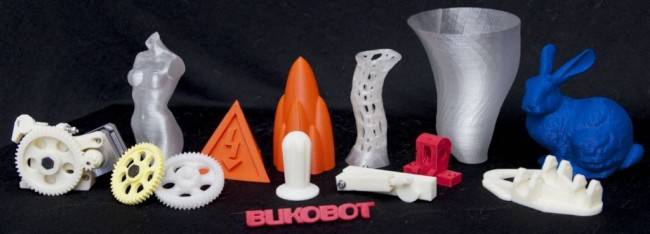
My Bukobot kits are all about quality. I think it’s very important in this new technology to have the best experience possible for it to become mainstream. I know there are some cheaper printers out there, but one way or another they compromise something to make them “good enough”. All my Bukobots kits will have the best motors, electronics and components possible to make sure that it’s durable, reliable and faster.
From a low cost upgrade to a fully assembled dual extruder model, a Bukobot will be less expensive than many other 3D printers without compromising performance. With the smart Buko framework, there are many versions to fit your budget or 3D printing needs. So don’t be afraid to start small with a “Mini” or “Green” version because the Bukobots can always be upgraded or expanded later. Keep in mind that the Bukobots follow the Reprap tradition of self replication. After you build your first Bukobot, you can eventually print out new parts for another one to share with friends and family.
The smart Buko framework is designed to make building a 3D printer much easier than ever without sacrificing print quality! Even for the less experienced, a Bukobot can take just a couple hours to build. Only simple tools are needed like allen keys, screw drivers, utility knife and needle nose pliers.
With a Bukobot, you can keep up with the times with simple upgrades, I tried my best to design the Buko framework as “future” compatible as possible. Want it to print higher? Want it to print faster? Not a problem! It may just take a few longer pieces of aluminum extrusions, longer cables (or belts) and rods or maybe some simple electronic parts to get to the next level.
With your support of the Bukobot, you will be helping to create the great documentation to guide you through the easy building process of a Bukobot 3D printer. I want to reduce the time people spend looking for answers on different websites and forums to find all the pieces of information. From shipping box to your first 3D print, I will try my best to be your prime source for documentation on the Bukobot.
One of the more difficult (and sometimes expensive) parts to get made for 3D printers are the laser cut pieces and machined parts. Seems like almost all the 3D printers have some form of laser cut acrylic, wood or special metal parts. I believe most people do not have access to a laser cutter or machine shop, so I eliminated this need in the design of the Buko framework. If it can’t be printed in 3D, bought off the shelf or made at home with simple tools, it’s not in the design.
With many 3D printers out there, I haven’t really seen any focused on the environment. The “Green” versions of Bukobots are just that, a more environmentally friendly 3D printer. There are three ways they have a less impact on the environment:

The Buko “Green” models are made to specifically work with PLA plastic only. PLA is a type of plastic that is made from corn starch (or sugar sometimes) and is biodegradable. PLA even gives off a soft burnt popcorn smell while printing. PLA is actually harder than ABS, which makes it ideal for mechanical applications than need a little more strength. Secondly, they consume less energy because PLA doesn’t require a heated platform to create 3D prints and it melts at a lower temperature than ABS plastic. This also makes it a bit safer for younger kids that want to explore 3D printing with their teachers and parents. Finally, being built mostly out of aluminum and plastics, you can easily recycle most of the printer itself (if you would ever need to).
The Buko framework introduces a couple of new engineering components rarely seen in 3D printers. A new material used on the Bukobots is Ultra-high-molecular-weight polyethylene (UHMW-PE). This special polyethylene material has some amazing properties and is actually not hard to find. This material is used in some parts on the Z axis to reduce components, increase longevity and to help make things quieter. The other new component being used is the stainless steel Syncromesh Cable. This new type of cable will replace all belts to lower costs while reducing space needed and increasing strength of the axis drive system.
A major reason I decided to create a new 3D printer is my disappointment with current speeds and rigidity. I have plenty of patience for normal things, but when it comes to waiting 3-4 hours for a small 3D printed part, it’s just not acceptable to me. To accomplish greater speed on a 3D printer you need a very sturdy frame and some amazing firmware. Bukobots have both. The aluminum extrusions are nearly impossible to bend and the design of the joints are made to be as strong and rigid as possible. With the amazing Marlin firmware, Bukobots are made to run faster than most from the start. With a good combination of a good extruder and powerful motors, it can probably go even faster. With a Bukobot, you can stop watching grass grow and get your 3D prints faster!
I made the look of the Bukobots an important part in my designs. I wanted my 3D printer to look cool and stand out from others. It was also important to have a very open area to see clearly what is being printed and to see how everything was working. Most of the 3D printed parts I designed have curves and cool angles to give things a more professional look. I also dedicated some valuable time to design wire guides that help hide and organize the wiring around the printer.
Being a “Reprap” type of 3D printer, the Buko framework design files will be released into the wild for the world to have. By supporting the Bukobot project, you will be helping to complete and improve these files. I strongly believe in open source and collaborative projects in technology.
General Features
The Buko framework has been designed from the ground up to be easy to build, sturdy, expandable and upgradeable. All the models have the ability to be expanded and upgraded in different ways. You can change things like increasing the size of the build volume or adding dual extruders in the future. I also designed the frame of the Bukobots to be very sturdy, which helps with accuracy and faster speeds. All the complete kits will also include the new “Syncromesh” cables instead of the more costly belts. With all these great technical features, you will also get a 3D printer that is amazingly easy to build.
“Bukito”
The “Bukito” models are the most economical 3D printer kits we can make. These have been design to be the most affordable kits by including just the essentials you need to make great 3D prints. Easy to build and excellent for beginners or if you want a small portable printer to take around with you.
“Green” Models
The “Green” models are the “Eco friendly” versions. These kits are designed specifically to use biodegradable PLA plastic only. Some advantages of using this plastic are:
“8” Models

The “8” means the model has a minimum print volume of 8x8x8 inches (200x200x200mm).
“Mini” Models

“Mini” model have a smaller print volume than the “8” to reduce overall costs. These have a print volume of about 5x5x6 inches (125x125x150mm)
“NE” Kits
“NE” means “No (Without) Electronics”. These models are meant for the folks that may already have a Reprap 3D printer (like the Prusa Mendel) and they would like to upgrade or use their own electronics. These kits are for the more experienced user since it requires to supply you’re own motors, controller, power supply and some other electronic components. These kits only include the following:
“Duo” Models

The “Duo” models have dual plastic extruders. These can be used to print a 3D object with two types of filament. Note: Dual extrusion is still experimental and some special programming may be required to setup and prepare objects to print in two colors or materials.